The Life of Incense: From Dough to Smoke
There is something unexpectedly difficult about describing incense dough.
It is not quite clay.
It is not quite batter.
It is damp and soft, but there is a gentle resistance when you press into it. It takes the impression of a fingertip immediately, yet holds enough structure to be rolled, pinched, folded, flattened, or shaped into something surprisingly precise.
The first time I touched it, I kept trying to compare it to materials I already knew.
Eventually I stopped trying.
Maybe the more interesting thing was simply to see what everyone else did with it.
What Happens When There Is No Correct Shape?
At the table, everyone began with the same material.
Very quickly, nothing looked the same.
Someone made an abstract cloud. Someone else made leaves and flowers. There was a tiny vase, small sculptural objects, and forms that did not really need names at all.
A few people stayed close to the familiar incense cone.
Others wandered away from it almost immediately.
I loved watching this happen because there was no moment when we said, “Now be creative.”
It happened on its own.
Perhaps the material encourages it. Clay carries so many familiar associations that we often approach it already thinking about a cup, a bowl, or a vessel. A blank sheet of paper can create another kind of pressure: now I need to draw something.
Incense dough seemed to sit somewhere else.
It gave the hands something to do before the mind had fully decided what it was making.
And slowly, forms appeared.
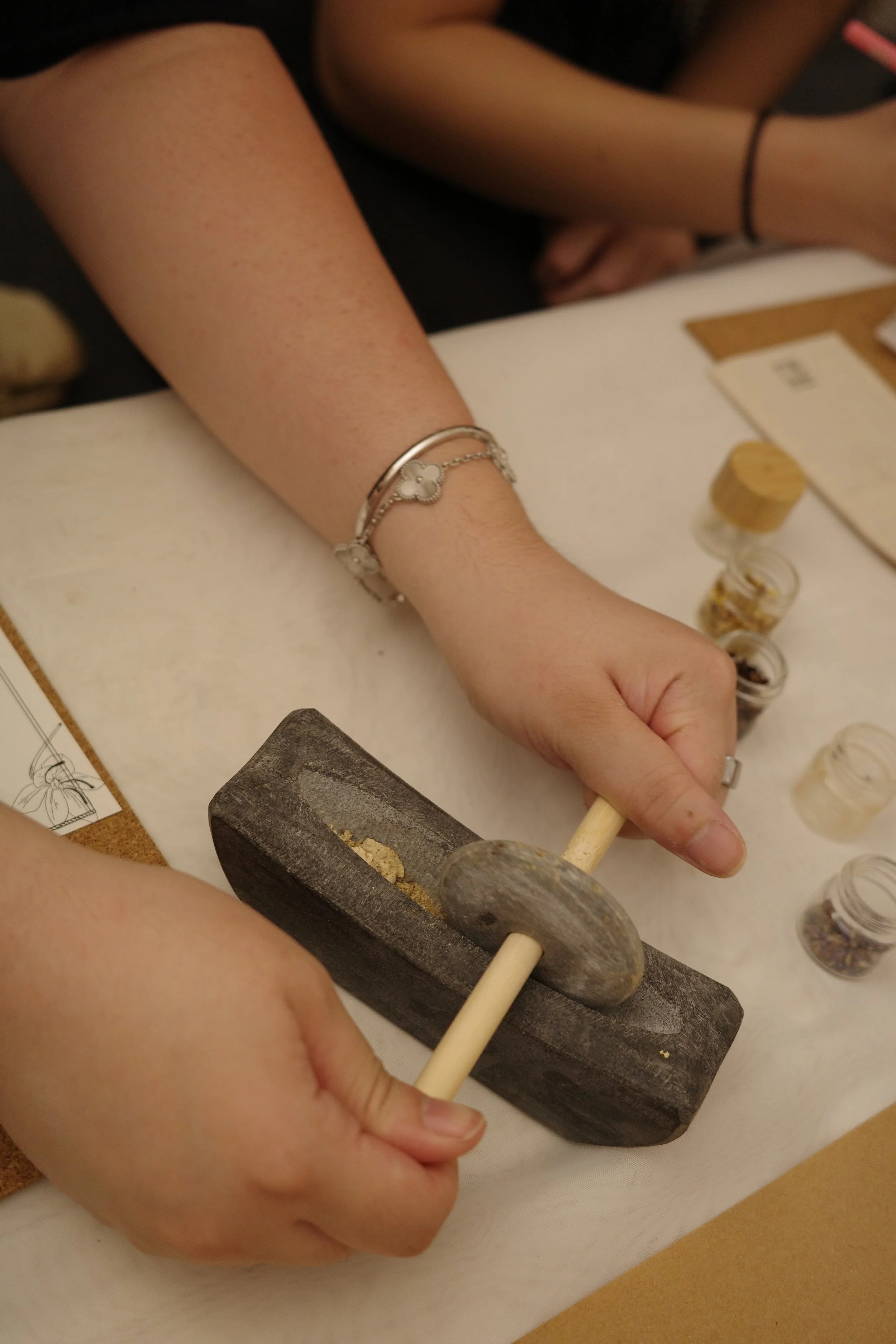
A guest testing out the traditional stone mortar, slowly grinding aromatic ingredients by hand.
Gathering of Scholars at the Western Garden
Unidentified artist, in the style of Zhao Mengfu
Ming or Qing dynasty
The Metropolitan Museum of Art
A gathering does not always need a single purpose. In paintings of scholars together, reading, music, conversation, objects, landscape, and time spent in one another’s company often coexist.
Before Incense Is Smoke
We usually meet incense in its finished state.
A stick in a box.
A cone on a tray.
A thin line of smoke.
Making it reverses that order.
Before it becomes smoke, incense is very physical.
Fresh incense dough has a strong presence. While we were working with it, the fragrance stayed close to our hands and around the table. The more we touched it, the more present the scent seemed to become.
At one point, a guest kept smelling the dough and finally asked Celine:
“Could you make this into hand cream?”
Everyone laughed.
But the question made complete sense.
At that moment, the incense did not feel like something that belonged in a burner. It felt botanical, almost cosmetic—something soft and fragrant that you might want to keep on your skin.
That small comment stayed with me.
Before incense becomes something we burn, we understand it in a completely different way: through touch, moisture, texture, and scent at very close range.
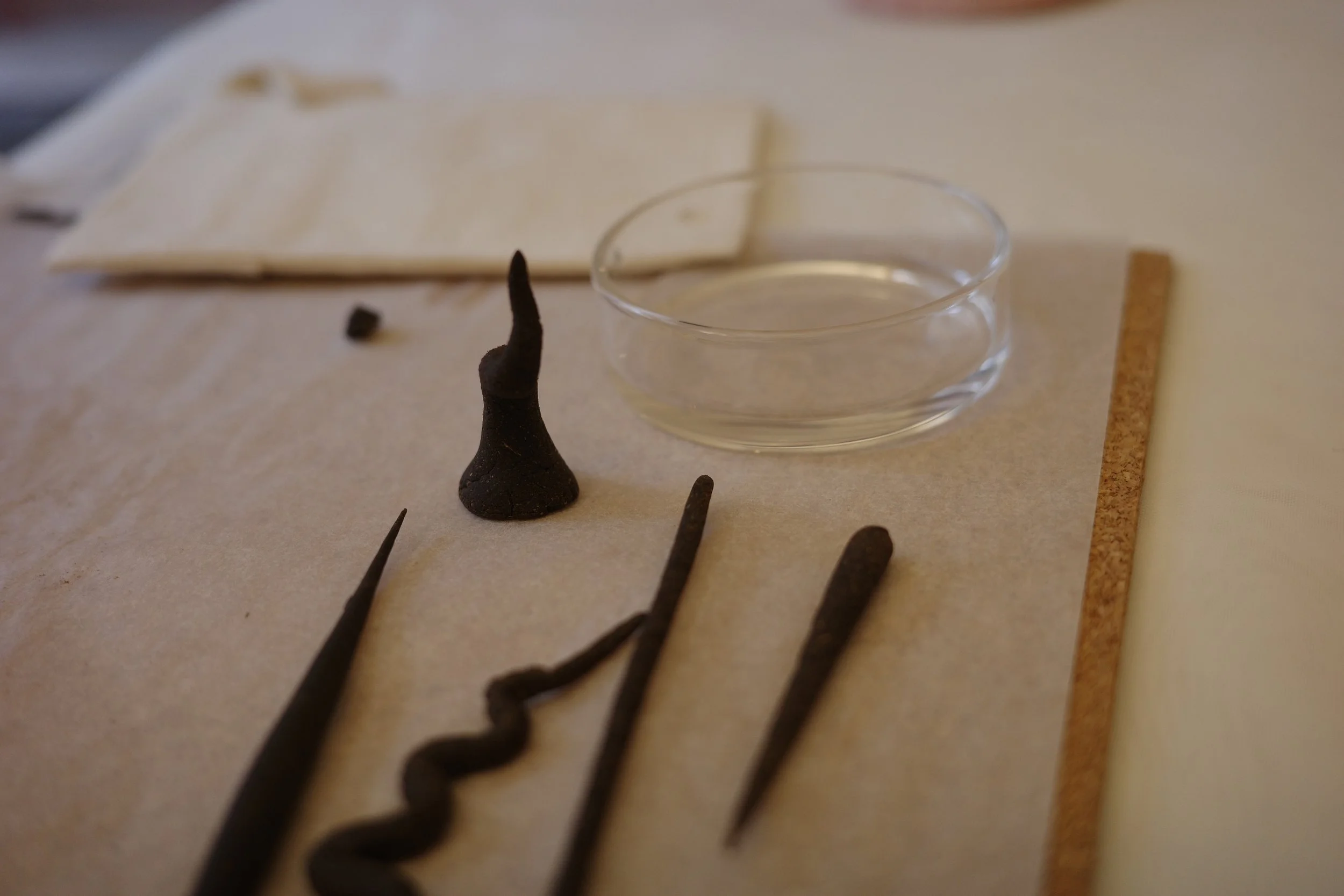
Wet, Dry, Burning
The next part requires waiting.
Freshly shaped incense cannot simply be lit.
It has to dry.
As the water gradually leaves the material, its texture hardens and its immediate fragrance becomes quieter. The transformation is slow enough that it can be easy to forget about the pieces sitting somewhere at home.
Then, when the incense is finally lit, there is another change.
Heat releases fragrance into the air, while combustion itself transforms the aromatic materials. What we experience while burning incense is therefore not simply the smell of the wet dough made stronger. It is another stage of the material altogether.
I started thinking of one piece of incense as having at least three lives:
wet, dry, and burning.
The wet fragrance sits close to your hands.
The dry object becomes almost sculptural.
And once lit, its form slowly gives way to heat, fragrance, smoke, and ash.
The same material keeps becoming something else.
A Much Older Habit
Of course, people have been paying attention to these transformations for a very long time.
Incense in China has had religious and ceremonial roles, but its history is also surprisingly domestic and everyday.
By the Song dynasty, imported aromatic materials had become part of a large trade, and incense was used not only in temples and palaces but also in homes and scholarly life. Bard Graduate Center describes scholars burning incense while practicing calligraphy and music, appreciating antiques, or sitting outdoors. It also notes that incense formed into sticks and cones was already well known by the Northern Song dynasty.
That detail interests me because it makes incense feel less remote.
It was not always an object separated from ordinary life by ceremony.
It could exist beside writing, listening, conversation, flowers, furniture, objects, and the simple act of spending time somewhere.
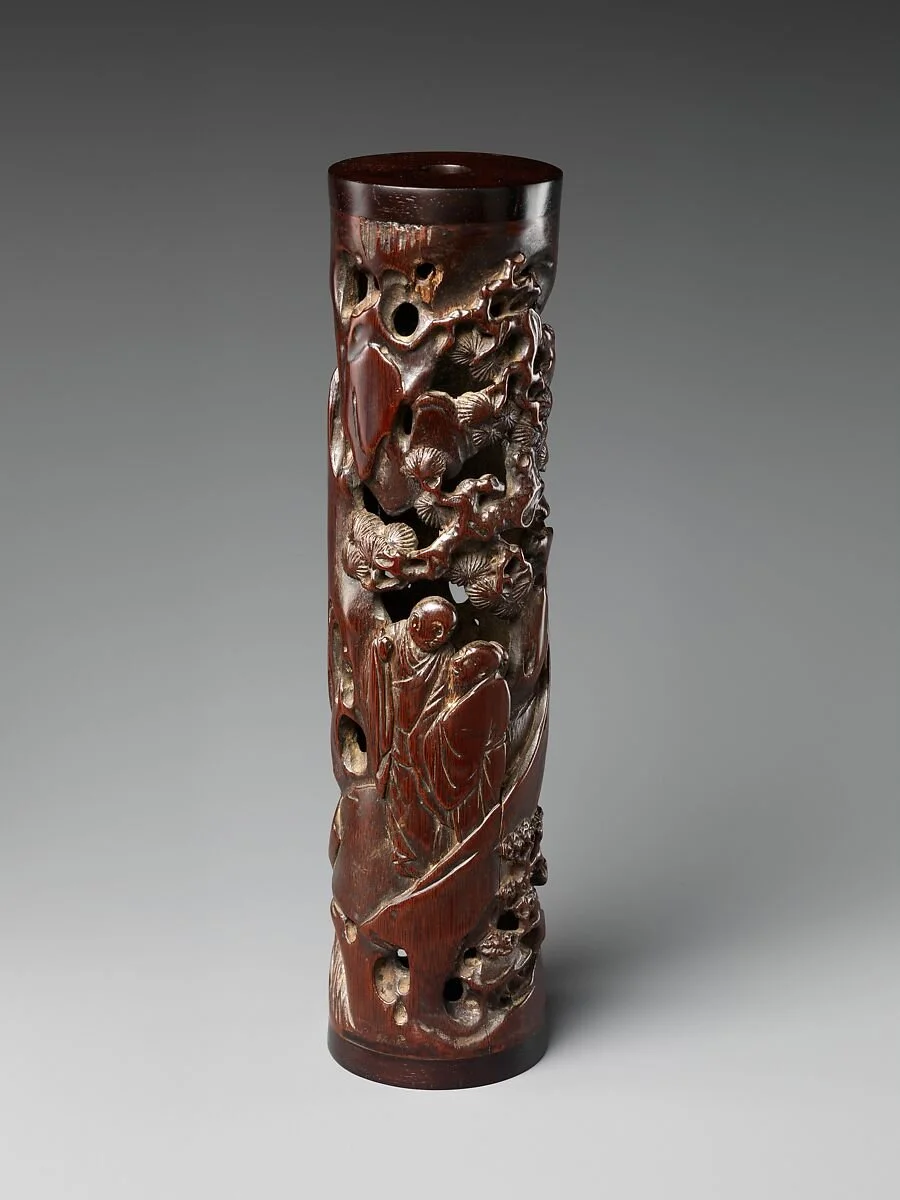
Zhu Sansong
Late 16th–early 17th century, Ming dynasty
Bamboo
The Metropolitan Museum of Art
The openwork carving was functional as well as decorative: it allowed fragrance from incense sticks burning inside to move out into the surrounding room. The carved scene depicts scholars within a landscape.
A Fragrant Pastime
Another Ming object at The Met is described in almost wonderfully ordinary language.
A sixteenth- to seventeenth-century bronze incense burner would have been used in a scholar’s studio and, in the museum’s words, treasured as a necessity for a “fragrant pastime.”
I like that phrase.
A pastime does not have to justify itself.
It can simply be something pleasurable enough to return to.
The historical context was, of course, very different from ours. But the impulse feels recognizable: arranging a few objects, making the room smell a certain way, handling materials slowly, doing something with your hands because the experience itself is satisfying.
Incense burner with fish-shaped handles
China, 16th–17th century
Copper alloy
The Metropolitan Museum of Art
Used in a scholar’s studio, an incense burner could be both a practical object and part of the visual life of the room.
“A Subtle Fragrance Fills the Sleeves”
Scent also appears constantly at the edges of Chinese poetry.
Not necessarily as the subject.
Often it is simply there.
In the Song dynasty, Li Qingzhao wrote in Zui Hua Yin (醉花阴):
瑞脑销金兽
borneol incense burns away in the gilded beast
and later:
有暗香盈袖
a subtle fragrance fills the sleeves
The poem takes place around the Double Ninth Festival in autumn. There is cooling night air, chrysanthemums, wine, an incense burner, and fragrance reaching the body almost incidentally. The surviving text includes both lines.
I especially like “fragrance fills the sleeves.”
Scent here is not something to look at.
It does not sit neatly inside an object.
It escapes.
It settles onto clothing.
It follows the body.
An Object Designed to Disappear
Most things we make are supposed to survive.
A ceramic bowl becomes successful partly because it remains a bowl.
A painting is completed so that it can continue to exist as a painting.
Incense is different.
Its disappearance is part of its function.
It begins as powders and aromatic materials.
Water temporarily brings those materials together into something soft enough to shape.
Drying gives the object stability.
Then fire takes that stability away.
What remains is fragrance, smoke, ash, and whatever memory we attach to the experience.
Perhaps this is why such a small object can feel unusually personal.
You spend time deciding what it should become, knowing that if you eventually use it, the thing you made will no longer exist in the same form.
That is not necessarily sad.
There is pleasure in that transformation too.
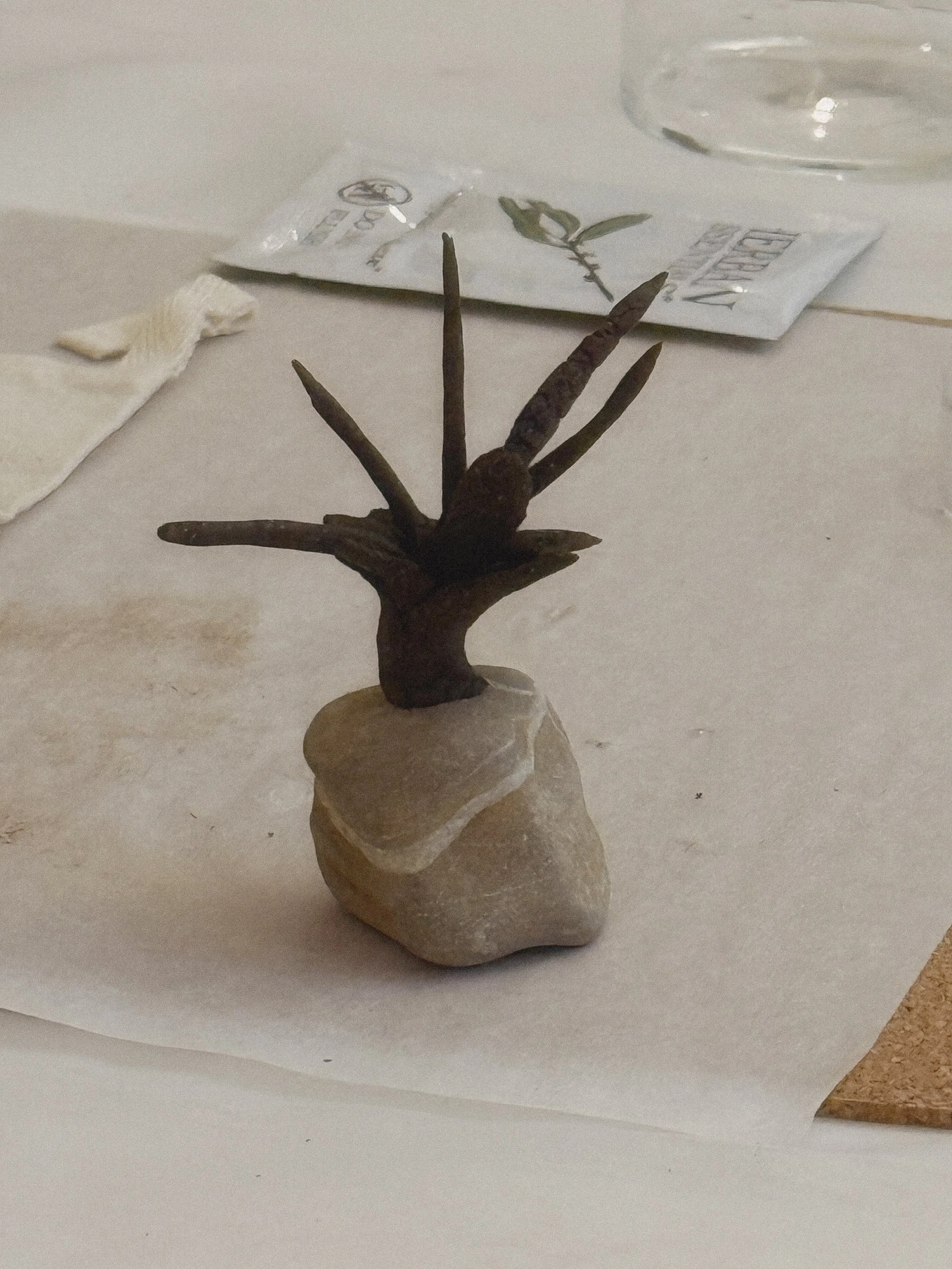
9/19/2026
Scent Rituals: A Hands-On Incense Workshop
What We Kept Thinking About
I expected the workshop to make me think more about fragrance.
Instead, I kept thinking about material.
How unfamiliar something can feel in your hands.
How quickly people begin inventing once they stop worrying about what an object is supposed to look like.
How the same piece smells different while wet, while dry, and while burning.
How one person sees incense and thinks immediately of fire.
Another sees a tiny sculpture and wants to keep it.
And how an object can pass through your hands, sit quietly for days, fill a room for a little while, and then disappear.
There is no correct way to respond to that.
Maybe that is the point.
Wet, it is something we touch.
Dry, it becomes an object.
Burning, it becomes something we can no longer hold.
Further Reading / Explore the History
For anyone curious to go deeper, these are a few places we found especially useful:
The Metropolitan Museum of ArtChinese Decorative Arts — The Metropolitan Museum of Art BulletinA museum publication exploring Chinese decorative objects, including Zhu Sansong’s carved bamboo incense holder and the relationship between material, craftsmanship, imagery, and use.
Bard Graduate CenterA Reverence for the PastA particularly useful essay on Chinese ritual vessels and incense burners. It traces the development of incense materials and practices, the Song-dynasty incense trade, the use of fragrance in scholarly and domestic life, and the emergence of stick and cone incense.
The Metropolitan Museum of ArtIncense Holder with Scholars in a Landscape — Zhu SansongA detailed object record for the late Ming bamboo incense holder shown above, including information about its carved imagery and the functional openwork that released fragrance from incense burning inside.
The Metropolitan Museum of ArtIncense Burner with Fish-Shaped HandlesA Ming-dynasty bronze censer associated with the scholar’s studio and what the museum describes as a “fragrant pastime.”
The Metropolitan Museum of ArtGathering of Scholars at the Western GardenA public-domain Ming or Qing painting showing an imagined gathering of scholars in a garden—a useful visual window into the larger world of scholarly sociability, art, music, objects, and leisure.
Chinese Text ProjectLi Qingzhao, Zui Hua Yin (醉花阴)The classical text of Li Qingzhao’s autumn poem, including the lines “瑞脑销金兽” and “有暗香盈袖.”Words and observations by Oblique Table, from an incense-making session with Celine of Scented Stranger.New York, Fall 2026.
